
What you’ll learn
- The 20 best DevOps services companies in the UAE, plus 12 more worth a look
- What each company does well, where it falls short, and who it suits
- Minimum project sizes and hourly rates side by side
- What DevOps services cost in the UAE and what drives the price
- How to pick the right partner, and the questions to ask before you sign
Most teams don’t call a DevOps company because things are fine. They call because releases are slow, deployments break, or the cloud bill keeps growing and nobody knows why.
The UAE has no shortage of firms that say they do DevOps. Some are AWS specialists with hundreds of certified engineers. Some are software houses that list DevOps next to mobile apps and AI. A few are large integrators that do DevOps as one service among fifty.
Quest Middle East’s DevOps services in the UAE sit at #1 on this list. Every other company here was judged the same way, and I’ve listed the cons for our own service too.
If you’re short on time, start with the shortlist and the overview table. If you’re about to sign a contract, read the how-to-choose and cost sections first. They’ll save you money.
Shortlist: the best DevOps services in UAE
- Quest Middle East: Best DevOps services in UAE overall
- Zero&One: Best for large AWS programmes
- SUDO Consultants: Best for 24/7 managed AWS operations
- Deployflow: Best for multi-cloud managed DevOps
- Stackgenie: Best for Kubernetes and Terraform work
- Integra Technologies: Best for app modernisation on AWS
- Bespin Global MEA: Best for multi-cloud management
- Cloud4C: Best for one SLA up to the application layer
- Sedin Technologies: Best for development and DevOps from one vendor
- Sigma Software: Best for long-term engineering teams
- GBM: Best for Red Hat OpenShift in large enterprises
- Deliverydevs: Best budget pick for small projects
How I reviewed these DevOps companies
I’m the Digital Marketing Manager at Quest Middle East. That’s a clear bias, so I want to be upfront about how this list was made.
I started with every UAE company I could find that offers DevOps as a real service, not a one-line mention. I used UAE DevOps and AWS partner listings, partner directories from AWS, Red Hat and Atlassian, company websites, and press releases. I checked all rates and credentials in November 2026.
I scored each company on six things:
- UAE presence: Is there a real office and team here, or just a sales contact?
- DevOps depth: CI/CD, infrastructure as code, containers, monitoring and security, not just one of them.
- Cloud credentials: Partner tiers and competencies with AWS, Microsoft, Google, Red Hat and others.
- Pricing clarity: Are rates, minimums or pricing factors shared up front?
- Engagement flexibility: Can you start with an assessment or a small project, or is it a big contract or nothing?
- Handover: Do you get runbooks, documentation and code you own when the work ends?
No company paid to be on this list. Where I couldn’t verify a claim, I said so or left it out.
Overview: the best DevOps services companies in UAE compared
| # | Company | Best for | UAE base | Min. project | Hourly rate |
|---|---|---|---|---|---|
| 1 | Quest Middle East | Best overall | BurJuman Tower, Dubai | Scoped per proposal | Custom Quote |
| 2 | Zero&One | Large AWS programmes | Dubai | Not public | Not public |
| 3 | SUDO Consultants | 24/7 managed AWS operations | Dubai Media City | $1,000+ | Not public |
| 4 | Deployflow | Multi-cloud managed DevOps | Burj Gate, Sheikh Zayed Road | $25,000+ | $50 to $99 |
| 5 | Stackgenie | Kubernetes and Terraform | Dubai | $5,000+ | $50 to $99 |
| 6 | Integra Technologies | App modernisation on AWS | Dubai Silicon Oasis | Not public | Not public |
| 7 | Bespin Global MEA | Multi-cloud management | Dubai | Not public | Not public |
| 8 | Cloud4C | One SLA up to the app layer | Dubai | Not public | Not public |
| 9 | Sedin Technologies | Development plus DevOps | Dubai | $10,000+ | $25 to $49 |
| 10 | Sigma Software | Long-term engineering teams | Business Bay, Dubai | $50,000+ | $50 to $99 |
| 11 | GBM | Red Hat OpenShift | UAE | Not public | Not public |
| 12 | slashTEC | DevOps as a service on AWS | Ibn Battuta Gate, Dubai | Not public | Not public |
| 13 | Flentas Technologies | AWS re-architecture | Dubai World Trade Centre | Not public | Not public |
| 14 | Urolime | Kubernetes and DevSecOps | BurJuman, Dubai | Not public | Not public |
| 15 | enreap | Atlassian-led DevOps toolchains | Dubai Media City | Not public | Not public |
| 16 | Mobcoder | App teams that need DevOps too | Sharjah | $25,000+ | $50 to $99 |
| 17 | Deliverydevs | Budget pick | Dubai | $1,000+ | $25 to $49 |
| 18 | UCGP Consult | Oracle workloads | Dubai | $1,000+ | $50 to $99 |
| 19 | VaporVM | DevOps plus security operations | Dubai | Not public | Not public |
| 20 | SmartCLOUD | Monitoring and DevSecOps | Dubai Silicon Oasis | Not public | Not public |
Minimum project sizes and hourly rates are in US dollars, as published in November 2026.
The 20 best DevOps services companies in UAE: detailed reviews
1. Quest Middle East: best DevOps services in UAE overall
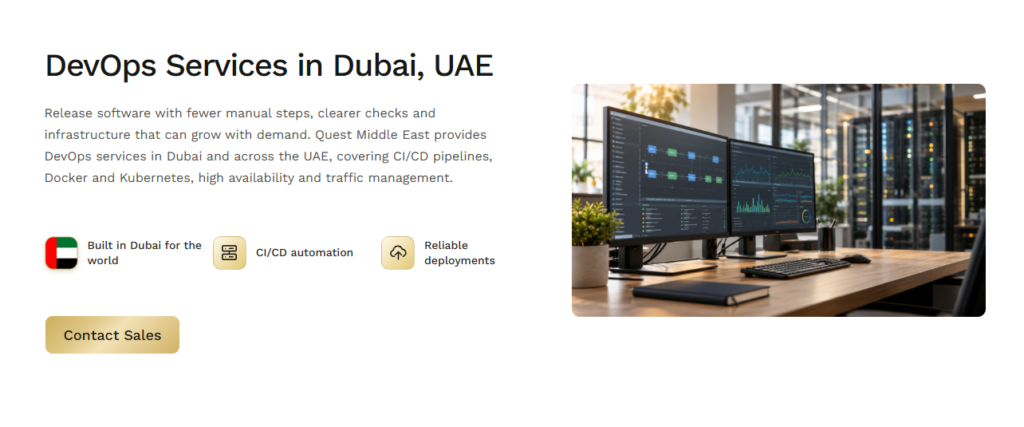
Quest Middle East is a Dubai IT company based in BurJuman Tower. Its DevOps services cover CI/CD pipelines, Docker and Kubernetes, high availability, auto-scaling, infrastructure as code, monitoring and pipeline security.
What I like most is the way Quest starts. It doesn’t open with a big rebuild. It reviews your current workflow, agrees one bounded first improvement, tests it outside production, then hands it over with documentation. You see results before you commit to more.
Quest also works with the tools you already use. If your team runs GitHub Actions, GitLab CI/CD, Jenkins or Azure Pipelines, the aim is to improve that setup, not replace it. And if your app doesn’t need Kubernetes, Quest will tell you so.
DevOps is one part of a wider service set. The same team handles cloud management across AWS, Microsoft Azure, Google Cloud, Oracle Cloud and Alibaba Cloud, plus server management, a managed NOC and cybersecurity services. Quest also builds and runs its own software products, like visitor, queue, parking, gate pass and dock management systems. So the team ships and supports software of its own.
With names like Shell, Dubai world trade centre, DP World, Hilton, Marriott and more industry leaders, Quest Middle East’s client base is a proof of the quality they provide.
Core services
- CI/CD pipeline design: Build, test and release workflows with approval rules and deployment gates
- Containers: Docker containerisation and Kubernetes deployment planning, only where it fits
- High availability: Load balancing, health checks, clustering and failover testing
- High traffic and auto-scaling: Load testing and capacity planning before peak periods
- Infrastructure as code: Version-controlled provisioning and configuration with Terraform and Ansible
- Release checks: Build validation, test stages and rollback criteria
- Monitoring and logging: Prometheus, Grafana or your existing cloud monitoring, with clear escalation routes
- Pipeline security: Access control and secrets handling for pipelines and credentials
Engagement options
- DevOps assessment: Finds bottlenecks and gaps, then sets the order to fix them
- Implementation project: A scoped pipeline, container, availability or traffic project with milestones
- Ongoing DevOps support: Continuous pipeline and infrastructure changes, with coverage hours and escalation written into the proposal
- Working with your developers: Quest works alongside your in-house team or your current software supplier
What you get at handover
- A documented release workflow: pipeline configuration, approval rules and validation checks
- Infrastructure and environment records: architecture notes, configuration files and an environment inventory
- Recovery instructions: runbooks, rollback criteria, escalation contacts and validation records
- A prioritised improvement plan with owners and next steps
Quest also tracks four practical measures: time from approved change to release, release reliability, recovery time after a failed release, and how the app behaves under load. These are used to judge progress, not sold as guarantees.
Pricing overview
Quest doesn’t publish fixed prices. Each proposal depends on the number of applications and environments, your current tooling, the complexity of the work and the engagement type. You can contact Quest with a short outline of your workflow to get a scoped quote. Don’t send passwords, tokens or source code in that first message.
Pros and cons
🟢 Starts with an assessment and one small, clear first improvement
🟢 Improves your current CI/CD tools instead of forcing a new stack
🟢 Honest advice, including when you don’t need Docker or Kubernetes
🟢 Clear handover: runbooks, rollback criteria, environment records and an improvement plan
🟢 One local team for DevOps, cloud, servers, NOC and security
🟢 Works across five clouds: AWS, Azure, Google Cloud, Oracle Cloud and Alibaba Cloud
🔴 No public pricing, so you’ll need a short scoping call
🔴 Cloud partner tiers and competencies aren’t listed on the website
🔴 If you want a huge bench across dozens of countries, a global integrator is a closer fit
💡 Tip: Ask for the DevOps assessment first. It gives you a written list of gaps and a clear order of work, even if you decide to do some of it in-house.
💡 Bottom line: Quest Middle East is the best DevOps services company in the UAE for most teams. You get a local team that fixes one thing at a time, keeps your tools, documents everything, and can also run your cloud, servers and security.
2. Zero&One: best for large AWS programmes
Zero&One is a cloud consultancy with teams in the UAE and Lebanon and an office in Riyadh. It was the first homegrown firm in the MENA region to reach AWS Premier Consulting Partner status. PwC Middle East bought a stake in 2022, and reports say NTT Data Middle East acquired the firm in early 2026.
Its AWS bench is deep. Zero&One holds AWS competencies in DevOps, Migration and Data and Analytics, plus the AWS Managed Service Provider designation and a Generative AI competency. In 2023, it reported around 200 AWS certifications.
Core services
- AWS DevOps consulting, CI/CD and automation
- Cloud migration and modernisation on AWS
- Managed AWS operations, support and maintenance
- Data, analytics and generative AI on AWS
- Observability work, as a Datadog Advanced Tier partner
Pricing overview
Zero&One doesn’t publish rates or minimums. Expect scoped proposals sized for mid-market and enterprise AWS programmes.
Pros and cons
🟢 AWS Premier tier with DevOps, Migration and MSP credentials
🟢 Large certified bench for big, multi-phase programmes
🟢 ISO 27001:2022 certified for information security
🔴 Built around AWS, so less suited to Azure-first or mixed-cloud teams
🔴 No public pricing
🔴 Recent ownership changes, so confirm who you’ll contract with
💡 Tip: Ask which AWS competency team will run your work, and who your day-to-day contact will be after the sale.
💡 Bottom line: A strong pick if you’re all-in on AWS and need a big, certified team. Smaller teams may find it more than they need.
3. SUDO Consultants: best for 24/7 managed AWS operations
SUDO Consultants was founded in 2019 and is based in Dubai Media City, with a second office in Riyadh. In 2025, it became an AWS Premier Tier Services Partner.
SUDO holds four AWS competencies: DevOps, Resilience, Generative AI and Managed Service Provider. It also lists 13 AWS service validations, more than 150 AWS-certified experts and more than 150 AWS customer launches.
Core services
- CI/CD pipelines and infrastructure as code
- Application modernisation with Amazon EKS
- 24/7 managed AWS operations with NOC and SOC monitoring
- AWS Well-Architected reviews and landing zones
- FinOps, right-sizing and cost optimisation
- Disaster recovery, backup and cloud security
Pricing overview
Its minimum project size is $1,000. Hourly rates aren’t public.
Pros and cons
🟢 AWS Premier tier with DevOps and Resilience competencies
🟢 Round-the-clock managed operations, not just project work
🟢 Low minimum project size for an AWS Premier partner
🔴 AWS-focused, so not the best fit for Azure or Google Cloud shops
💡 Tip: If uptime is your main worry, ask SUDO to walk you through a Resilience review of one workload before you sign a managed services deal.
💡 Bottom line: SUDO is a good choice for AWS teams that want DevOps and 24/7 operations from the same certified partner.
4. Deployflow: best for multi-cloud managed DevOps
Deployflow is a UK company with a Dubai office at Burj Gate on Sheikh Zayed Road. Most of its work is DevOps managed services and AI development.
Deployflow partners with Microsoft Azure, AWS and Google Cloud. It holds ISO 27001 and Cyber Essentials Plus. Its work covers Kubernetes, Terraform, Ansible, Jenkins, GitHub and Azure DevOps.
Core services
- DevOps managed services and CI/CD
- DevOps strategy and microservices deployment
- Cloud consulting and migration across Azure, AWS and Google Cloud
- Security reviews and remediation
- AI development, which now makes up a large part of its work
Pricing overview
Minimum project size is $25,000, with rates of $50 to $99 an hour.
Pros and cons
🟢 ISO 27001 and Cyber Essentials Plus certified
🟢 Also handles security audits and fixes
🟢 Works across all three major clouds
🔴 $25,000 minimum rules out small projects
🔴 Most of its team is in the UK rather than Dubai
💡 Tip: Ask how many engineers sit in Dubai versus the UK, and agree on-site days in the contract if they matter to you.
💡 Bottom line: Deployflow suits mid-size and larger teams that want managed DevOps across more than one cloud and can meet the minimum spend.
5. Stackgenie: best for Kubernetes and Terraform work
Stackgenie was founded in 2020 and has a Dubai office among its ten locations worldwide.
Its sweet spot is hands-on infrastructure work. Its projects include Kubernetes troubleshooting, Terraform builds, AWS cost cuts and auto-scaling with Karpenter. One client used it to run Android simulators on demand. Another got an on-premise Kubernetes platform with load tests and staff training.
Core services
- DevOps managed services and Azure DevOps support
- Kubernetes, Docker and container platforms
- Terraform and policy as code
- Cloud architecture, migration and FinOps
- DevSecOps and identity integrations
Pricing overview
Minimum project size is $5,000, with rates of $50 to $99 an hour.
Pros and cons
🟢 Low $5,000 minimum for a specialist team
🟢 Strong Kubernetes and Terraform skills, on cloud and on-premise
🟢 Takes small, ad hoc jobs like fixing a broken pipeline
🔴 Rates sit in the higher $50 to $99 band
🔴 Small UAE footprint compared with its global spread
💡 Tip: Stackgenie is worth a call when one specific Kubernetes or Terraform problem is blocking your team.
💡 Bottom line: A sharp technical team for container and infrastructure-as-code work, at a lower entry point than most.
6. Integra Technologies: best for app modernisation on AWS
Integra Technologies is based at Dubai Digital Park in Dubai Silicon Oasis. It’s an AWS Advanced Consulting Partner with the AWS DevOps competency. It also partners with Red Hat and JFrog.
Integra’s DevOps work leans toward modernisation. One example is a large real estate company that moved to a centralised, microservices-based setup on AWS. It serves commercial and public sector clients.
Core services
- AWS DevOps consulting and architecture design
- CI/CD pipeline automation
- Microservices and application modernisation
- Cloud migration and workload optimisation
- Infrastructure setup and integration on AWS
Pricing overview
Integra doesn’t publish rates. Pricing is set per project.
Pros and cons
🟢 AWS DevOps competency backed by an Advanced tier partnership
🟢 Red Hat and JFrog partnerships help with enterprise toolchains
🟢 Public sector experience
🔴 No public pricing
🔴 Mostly AWS-focused
💡 Tip: If you’re breaking up a monolith, ask Integra for a reference from a similar modernisation project.
💡 Bottom line: A solid pick for larger teams moving legacy apps to microservices on AWS.
7. Bespin Global MEA: best for multi-cloud management
Bespin Global MEA operates from Dubai and serves the Middle East and Africa. It holds the AWS DevOps competency and AWS Well-Architected partner status. It also lists Azure Expert MSP and Premier Google Cloud partner status.
Its edge is OpsNow, an in-house multi-cloud management platform. That helps if you run workloads across AWS, Azure and Google Cloud and want one view of cost and operations.
Core services
- CI/CD and microservices
- Application and database migration
- Performance and cost optimisation
- Multi-cloud management through OpsNow
- Cloud strategy and big data
Pricing overview
No public pricing. Engagements are scoped per client.
Pros and cons
🟢 Credentials across AWS, Azure and Google Cloud
🟢 Own multi-cloud management platform
🔴 Its DevOps competency news dates back a few years, so confirm current status
🔴 No public pricing
💡 Tip: Ask for a demo of OpsNow with your own cloud accounts before you commit.
💡 Bottom line: A good fit for multi-cloud teams that want DevOps and cost control from one partner.
8. Cloud4C: best for one SLA up to the application layer
Cloud4C is a Singapore-based managed cloud provider with a Dubai location. It says it serves more than 2,500 enterprises across 25 countries, with more than 1,600 experts. It holds Azure Expert MSP status and is a premium partner for RISE with SAP.
Cloud4C’s pitch is a single SLA that runs from infrastructure up to the application layer. That appeals to large firms that want one partner to hold to account.
Core services
- DevOps on AWS, Azure and Google Cloud
- Kubernetes services and container management
- Cloud managed services, including SAP and Oracle
- Managed SOC and MDR
- Managed services automation
Pricing overview
No public rates or minimums. Expect enterprise-sized contracts.
Pros and cons
🟢 One SLA from infrastructure to application
🟢 SAP and Oracle managed services under the same roof
🟢 Security operations in the same contract
🔴 No public pricing
🔴 Likely too large and formal for small teams
💡 Tip: Read the SLA closely. Check which apps are in scope and what counts as downtime.
💡 Bottom line: Best for big enterprises, especially SAP shops, that want DevOps inside a full managed cloud deal.
9. Sedin Technologies: best for development and DevOps from one vendor
Sedin Technologies has been around since 2006. It’s headquartered in California, with offices in Dubai, Chennai and Bengaluru. It has more than 550 people.
DevOps is about a fifth of Sedin’s work. The rest is mostly custom software, testing, data and staff augmentation. That makes it handy if you need developers and DevOps engineers from the same vendor. One client uses Sedin for tier 1 alert and incident triage for its site reliability team.
Core services
- DevOps managed services and infrastructure management
- Site reliability support, including alert and incident triage
- Cloud migration, such as legacy .NET apps to Azure
- Custom software development and testing
- Data engineering and BI
Pricing overview
Minimum project size is $10,000, with rates of $25 to $49 an hour.
Pros and cons
🟢 Large team of more than 550 people
🟢 Lower hourly rates than most firms here
🟢 Can staff development, testing and DevOps together
🔴 Teams sit across several time zones, so overlap hours need planning
🔴 DevOps is only about a fifth of its work
💡 Tip: Agree the overlap hours with your UAE team before the work starts.
💡 Bottom line: A good value pick when DevOps is one part of a bigger software project.
10. Sigma Software: best for long-term engineering teams
Sigma Software was founded in 2002 and is headquartered in Ukraine. It has a small team at Bay Square in Business Bay, Dubai, and more than 1,000 people overall.
Sigma lists both AWS DevOps and Azure DevOps among its cloud skills. It also offers infrastructure as code, monitoring with Grafana and Prometheus, and long-term support.
Core services
- DevOps consulting and infrastructure design
- CI/CD pipeline setup and tuning
- Cloud migration and system modernisation
- Infrastructure as code
- Monitoring with Grafana and Prometheus
Pricing overview
Minimum project size is $50,000, with rates of $50 to $99 an hour.
Pros and cons
🟢 More than 20 years in business
🟢 Covers both AWS DevOps and Azure DevOps
🟢 Large pool of engineers for long engagements
🔴 $50,000 minimum is the highest on this list
🔴 Small Dubai team, with most engineers based abroad
💡 Tip: Ask to meet the named engineers before you sign, so you know who’ll be on your account.
💡 Bottom line: A safe choice for larger firms that want a stable team for a year or more.
11. GBM: best for Red Hat OpenShift in large enterprises
Gulf Business Machines (GBM) has worked in the Gulf for more than 35 years. It has over 1,500 people across seven offices in the region. It was the first company in the region to join Red Hat’s Partner Practice Accelerator for application development.
GBM is a big integrator, and DevOps is one part of a large portfolio. Its strength is application modernisation on Red Hat OpenShift, from design to deployment. It’s also a long-time IBM partner.
Core services
- Application modernisation on Red Hat OpenShift
- Digital infrastructure and hybrid cloud
- Digital business solutions
- Security services
- Managed services
Pricing overview
No public pricing. Expect enterprise-sized contracts.
Pros and cons
🟢 More than 35 years of experience in the Gulf
🟢 Strong Red Hat and IBM ties for hybrid and on-premise setups
🟢 Big team that can run large programmes
🔴 DevOps isn’t its main focus
🔴 Too big and formal for most small or mid-size teams
💡 Tip: If you already run OpenShift or IBM software, GBM should be on your shortlist.
💡 Bottom line: The right call for large enterprises on Red Hat, less so for cloud-native startups.
12. slashTEC: best for DevOps as a service on AWS
slashTEC is a Dubai firm based in the Ibn Battuta Gate building. It’s listed as an AWS partner with DevOps skills, and it offers DevOps as an ongoing service rather than one-off projects.
Its project examples include moving apps to microservices, adding Kubernetes clusters and building multi-region setups to handle traffic spikes.
Core services
- DevOps implementation and automation on AWS
- CI/CD pipeline design and tuning
- Kubernetes and container management
- Infrastructure as code and configuration management
- Cloud migration and modernisation
- DevOps as a service with ongoing support
Pricing overview
No public pricing.
Pros and cons
🟢 Ongoing DevOps as a service, not just projects
🟢 Multi-region and traffic spike experience
🔴 No public pricing
🔴 AWS-focused
💡 Tip: If your traffic spikes around sales or events, ask slashTEC how it load tests before a peak.
💡 Bottom line: A good fit for AWS teams that want a steady DevOps partner on a monthly basis.
13. Flentas Technologies: best for AWS re-architecture
Flentas has a Dubai office in Sheikh Rashid Tower at the Dubai World Trade Centre. It’s listed as an AWS DevOps competency partner with certified teams.
Flentas often works on re-architecture, such as moving monolithic systems to microservices on AWS.
Core services
- AWS DevOps consulting and implementation
- CI/CD automation and management
- Infrastructure as code
- Cloud migration and re-architecture
- Monitoring and log analysis
Pricing overview
No public pricing.
Pros and cons
🟢 AWS DevOps competency
🟢 Monolith-to-microservices experience
🔴 No public pricing
🔴 Little public detail on UAE clients
💡 Tip: Ask Flentas how it plans the cut-over from the old system to the new one, and how rollback works.
💡 Bottom line: Worth a look if your main goal is breaking up an old AWS monolith.
14. Urolime: best for Kubernetes and DevSecOps for SMEs
Urolime is a Dubai company in the BurJuman area. It does DevOps consulting, Kubernetes, DevSecOps and 24/7 monitoring, plus software development and managed IT.
That mix makes it a fit for small and mid-size firms that want DevOps and day-to-day IT support from one place.
Core services
- DevOps consulting and implementation
- CI/CD setup and automation
- Kubernetes consulting and container orchestration
- DevSecOps and security integration
- AWS migration and infrastructure support
- 24/7 monitoring and managed IT
Pricing overview
No public pricing.
Pros and cons
🟢 DevSecOps and 24/7 monitoring on offer
🟢 Covers DevOps, software and managed IT
🔴 No public pricing
🔴 Partner credentials aren’t public
💡 Tip: Ask what “24/7 monitoring” covers: alerts only, or alerts plus an engineer who fixes the issue.
💡 Bottom line: A practical option for SMEs that want Kubernetes help and round-the-clock monitoring.
15. enreap: best for Atlassian-led DevOps toolchains
enreap has an office in Dubai Media City and is listed in Atlassian’s partner directory for Dubai. It’s also an Atlassian Specialized Partner in Cloud.
That makes enreap a natural fit if your team lives in Jira, Confluence and Bitbucket. It links planning, code and releases in one toolchain, then adds cloud DevOps on top.
Core services
- DevOps consulting and advisory
- CI/CD pipeline design and implementation
- Infrastructure as code with CloudFormation and Terraform
- Monitoring, logging and performance tracking
- DevSecOps integration
- Managed DevOps and platform operations
Pricing overview
No public pricing for services. Atlassian licences are billed separately.
Pros and cons
🟢 Atlassian specialist, so Jira and Bitbucket workflows are in good hands
🟢 Covers both tooling and cloud DevOps
🔴 No public pricing for services
🔴 Less useful if your team doesn’t use Atlassian tools
💡 Tip: Ask enreap to map how a Jira ticket flows to a production release in your setup. Gaps show up fast.
💡 Bottom line: The best pick for Atlassian-heavy teams that want their toolchain and pipelines joined up.
16. Mobcoder: best for app teams that need DevOps too
Mobcoder is a US-based software company with a UAE office in Sharjah and another in Riyadh.
Mobcoder is mainly an app and software builder. DevOps is a smaller part of its work. But if you’re building a new product and need DevOps set up from day one, having one team do both saves hand-offs.
Core services
- DevOps and CI/CD for new products
- Mobile and web app development
- AI development
- IT staff augmentation and dedicated teams
- Cloud work on AWS, Google Cloud and Azure
Pricing overview
Minimum project size is $25,000, with rates of $50 to $99 an hour. Mobcoder also lists packages, such as staff augmentation from $6,500 a month and dedicated teams from $20,000 a month.
Pros and cons
🟢 Works across AWS, Google Cloud and Azure
🟢 Published package prices make budgeting easier
🟢 One team for the app and its pipeline
🔴 DevOps isn’t its core focus
🔴 $25,000 minimum is high for small DevOps jobs
💡 Tip: Write the DevOps work into the statement of work line by line. Don’t assume it’s included.
💡 Bottom line: Good for product teams building something new. Pick a DevOps specialist for complex existing setups.
17. Deliverydevs: best budget pick for small projects
Deliverydevs is a small Dubai firm with fewer than 50 people. About a quarter of its work is DevOps, with the rest split between ERP and cybersecurity.
It’s one of the few firms here with a $1,000 minimum and $25 to $49 hourly rates. That makes it easy to test on a small job first.
Core services
- DevOps optimisation
- CI/CD pipelines
- Infrastructure work
- ERP implementation
- Cybersecurity
Pricing overview
Minimum project size is $1,000, with rates of $25 to $49 an hour.
Pros and cons
🟢 Lowest entry price on this list
🟢 Covers DevOps, ERP and cybersecurity
🔴 Small team of under 50 people
🔴 Not built for large, complex programmes
💡 Tip: Start with one clear task, like fixing a flaky pipeline, and grow from there if it goes well.
💡 Bottom line: A sensible budget pick for small teams with small DevOps jobs.
18. UCGP Consult: best for Oracle workloads
UCGP Consult is a small Dubai firm with fewer than 50 people. Its work splits evenly across DevOps, cloud, ERP and managed IT. It offers DevOps as an ongoing “Ops as a Service” model.
Its standout skill is Oracle. If your core systems run on Oracle databases or Oracle Cloud, that’s useful and hard to find.
Core services
- DevOps Ops as a Service
- Cloud consulting
- Oracle and ERP expertise
- IT managed services
Pricing overview
Minimum project size is $1,000, with rates of $50 to $99 an hour.
Pros and cons
🟢 Oracle expertise alongside DevOps
🟢 Low minimum project size
🔴 DevOps is one of four equal service areas
🔴 Small team of under 50 people
💡 Tip: Ask UCGP how it handles database changes in your pipeline. That’s where Oracle setups often get stuck.
💡 Bottom line: A niche but useful pick for Oracle-heavy companies.
19. VaporVM: best for DevOps plus security operations
VaporVM is a Dubai IT company registered in DMCC. It’s an IBM partner and lists managed SOC services in IBM’s partner directory. It also hires cloud DevOps engineers for client work.
Its value is pairing cloud and DevOps work with security operations, which suits firms with strict security needs.
Core services
- Managed cloud services
- Cloud DevOps
- Managed SOC services
- Cloud security architecture
Pricing overview
No public pricing.
Pros and cons
🟢 Security operations next to DevOps
🟢 IBM partnership
🔴 No public pricing
🔴 Little public detail on DevOps projects
💡 Tip: Ask for a sample of the security reports you’ll get each month.
💡 Bottom line: Worth a call if security monitoring matters as much as faster releases.
20. SmartCLOUD: best for monitoring and DevSecOps
SmartCLOUD is based in Apricot Tower in Dubai Silicon Oasis. It works across multi-cloud setups, including AWS.
Its tool list is clear and practical: Terraform and Ansible for infrastructure as code, Kubernetes for containers, and Prometheus and Grafana for monitoring.
Core services
- DevOps consulting and implementation
- CI/CD automation
- Infrastructure as code with Terraform and Ansible
- Kubernetes and container management
- Security built into DevOps
- Monitoring with Prometheus and Grafana
Pricing overview
No public pricing.
Pros and cons
🟢 Open-source tool stack you won’t be locked into
🟢 Security and monitoring included
🔴 No public pricing
🔴 Partner credentials aren’t public
💡 Tip: Ask for sample Grafana dashboards and alert rules from a past project.
💡 Bottom line: A good option for teams that want solid monitoring built on open-source tools.
Even more DevOps companies in UAE to choose from
These didn’t make my top 20, but each one is worth a look for the right project.
- CloudFlex: A US company with a Dubai office and a $10,000 minimum. DevOps sits next to AI, web and mobile work.
- Matrix Bricks: A small team with a $1,000 minimum. It offers DevOps development services in the UAE.
- PufferSoft: A Dubai cloud consultancy focused on AWS migration and microservices work.
- Mobiloitte: A large team with rates of $25 to $49 an hour. DevOps is a small share next to AI, blockchain and mobile apps.
- Launch Ventures: A Dubai software firm that handles DevOps and CI/CD alongside mobile and AI work.
- Code Genesis: A Dubai software firm with a $5,000 minimum and part of its work in DevOps managed services.
- SolidStack: Based in Dubai Silicon Oasis. Offers DevOps, backup and disaster recovery, cost tuning and ERPNext hosting on AWS.
- Techcronus: Based at Meydan. Offers CI/CD, database migration to AWS and managed cloud operations.
- Antino: Based in Barsha Heights. Offers containers, configuration management and DevSecOps.
- Creator Shadow: Based near the Trade Centre. Offers DevOps setup plus training and support for in-house teams.
- 2 Cloud: A Ras Al Khaimah cloud consultancy set up in 2019, with about a quarter of its work in DevOps.
- ConsultoPlus: A small Abu Dhabi firm set up in 2024 that splits its work between DevOps and cloud consulting.
How to choose the right DevOps services company in UAE
Picking a DevOps partner on price alone often means paying twice to fix the work. These steps will help you avoid that.
- Name the problem first. Is it slow releases, failed deployments, downtime, a messy cloud bill or security gaps? Write it in one sentence. Every good DevOps company will ask you this anyway.
- Map what you have today. List your code repositories, CI/CD tool, cloud provider, environments and who approves releases. This makes quotes faster and more accurate.
- Pick the type of engagement. An assessment, a fixed project, ongoing support or extra engineers for your team. Each one is priced differently.
- Match the cloud. If you’re all-in on AWS, an AWS Premier or Advanced partner makes sense. If you use more than one cloud, or have servers on-premise too, pick a firm that works across all of them.
- Ask for references. Ask for one reference from a project like yours, and speak to that client directly.
- Ask how they handle access and secrets. A good partner never asks for passwords by email. It uses named accounts, least-privilege access and a secrets manager.
- Insist on documentation. You should get runbooks, rollback steps and infrastructure code stored in your own repository. If they leave, you keep everything.
- Agree how you’ll measure success. Common measures are how often you release, how long a change takes to go live, how often releases fail, and how fast you recover.
- Start small. Begin with one app or one pipeline. If it works, scale up. If it doesn’t, you’ve lost weeks, not months.
- Check support hours. Business hours or 24/7? Who picks up the phone on a Saturday night? Get the escalation path in writing.
Key DevOps services to look for
Not every company offers all of these. Use this list to check what’s in, and what’s missing, from each proposal.
Build and release
- CI/CD pipeline design: Automated build, test and release steps in tools like GitHub Actions, GitLab CI/CD, Jenkins or Azure Pipelines
- Release checks: Build validation, automated tests and approval gates before anything reaches production
- Rollback plans: A tested way to undo a bad release in minutes, not hours
- Environment management: Development, staging and production set up the same way, so “it worked on my machine” stops happening
Infrastructure
- Infrastructure as code: Servers, networks and cloud resources defined in code with Terraform, Ansible, CloudFormation or Bicep
- Containers: Docker images for consistent builds
- Kubernetes: Managed clusters on Amazon EKS, Azure AKS, Google GKE or Red Hat OpenShift, but only where your app needs it
- High availability: Load balancing, health checks, clustering and failover that’s actually been tested
- Auto-scaling: Capacity that grows with traffic and shrinks after, backed by load tests
Operations
- Monitoring and logging: Dashboards and alerts with Prometheus, Grafana or your cloud’s own tools
- Escalation routes: Clear rules for who gets alerted, when and how
- 24/7 monitoring: Round-the-clock cover through a managed NOC if downtime is costly for you
- Backup and disaster recovery: Tested backup and recovery for data and systems
- Cost control: Right-sizing, scheduling and clean-up to cut cloud waste
Security (DevSecOps)
- Secrets management: No passwords or keys stored in code or pipelines
- Access control: Named accounts, least-privilege roles and audit logs
- Code and image scanning: Checks for known flaws in code, libraries and containers before release
- Cloud security: Hardened settings and ongoing checks through cloud security services
Handover and support
- Documentation: Runbooks, architecture notes and an environment inventory
- Knowledge transfer: Walkthroughs and training for your own team
- Improvement plan: A prioritised list of next steps with owners
- Ongoing support: Defined coverage hours, response times and escalation contacts
How much do DevOps services cost in UAE?
Most UAE DevOps companies don’t publish prices. The ones that do publish them in US dollars. Here’s what the public data shows for the companies on this list.
| Published hourly rate | Roughly in AED | Companies on this list |
|---|---|---|
| $25 to $49 | AED 92 to 180 | Sedin Technologies, Deliverydevs |
| $50 to $99 | AED 184 to 364 | Deployflow, Stackgenie, Sigma Software, Mobcoder, UCGP Consult |
| Not public | Quote only | Quest Middle East, Zero&One, SUDO, Integra, Bespin Global, Cloud4C, GBM and others |
Minimum project sizes range from $1,000 (about AED 3,700) at SUDO, Deliverydevs and UCGP, up to $50,000 (about AED 184,000) at Sigma Software.
The bigger driver is how you buy the work. Here’s how each engagement type is usually priced.
| Engagement type | How it’s usually priced | What drives the cost |
|---|---|---|
| DevOps assessment | Fixed fee | Number of apps and environments, and how deep the review goes |
| Implementation project | Fixed price or milestones | Scope, number of pipelines, complexity and compliance needs |
| Ongoing DevOps support | Monthly retainer | Coverage hours, number of environments and response times |
| Extra engineers or a dedicated team | Monthly per engineer or team | Seniority, team size and contract length |
For a public example, Mobcoder lists staff augmentation from $6,500 a month (about AED 23,900) and dedicated teams from $20,000 a month (about AED 73,500).
What pushes the price up
- More applications, environments or cloud accounts
- Old apps with manual steps and tangled dependencies
- 24/7 cover instead of business hours
- Strict compliance or audit needs
- Moving to Kubernetes when your app doesn’t need it
Costs on top of the service fee
- Your cloud bill, which the DevOps company doesn’t usually pay
- Tool licences, such as GitHub, GitLab, Atlassian or paid monitoring tools
- Log and metrics storage, which grows over time
- Change requests outside the agreed scope
- 5% VAT on services from UAE-registered companies
How to keep the cost down
- Start with an assessment, then fix the top two or three issues first
- Keep the tools you have if they work
- Choose business-hours support for non-critical systems
- Make sure all code and documentation lands in your own repository, so you’re never locked in
At Quest, pricing depends on the number of apps and environments, your current tools, complexity and the engagement type. You can ask for a scoped proposal with a short outline of your setup.
Benefits of hiring a DevOps services company
- Faster releases: Automated pipelines cut the wait between “approved” and “live”.
- Fewer failed deployments: Tests and release checks catch problems before your customers do.
- Faster recovery: Tested rollback steps and runbooks turn a long outage into a short one.
- Same setup everywhere: Infrastructure as code keeps development, staging and production in step.
- Better security: Secrets, access and scanning are built into the pipeline, not bolted on later.
- Lower cloud waste: Right-sizing and auto-scaling mean you pay for what you use.
- Skills without hiring: Hiring senior DevOps engineers takes time. A partner gives you that skill set without the recruitment wait.
- More time for your developers: They write features instead of fighting servers and broken builds.
- Knowledge you keep: Good partners leave documentation, so your setup doesn’t live in one person’s head.
How a DevOps engagement works
Most good DevOps engagements follow the same basic path. Here’s what it looks like with a partner like Quest.
- Intro call. You share the problem, your tools and your cloud setup. No passwords or source code at this stage.
- Workflow review. The team maps your repositories, environments, dependencies and who does what during a release.
- Agree the first improvement. You pick one clear starting point, with acceptance criteria, approvals and access rules agreed up front.
- Build and test. Changes are made and tested in a non-production environment first. Rollback steps and maintenance windows are planned before anything goes live.
- Roll out. The change goes to production in a planned window, with the team watching closely.
- Handover. You get configuration files, runbooks and operating notes. The team walks your people through them.
- Improve and support. You prioritise the next round of work, or move to ongoing support with agreed coverage hours and escalation contacts.
If you also need help running the cloud itself, DevOps work often links up with cloud management or a cloud migration.
What’s the best DevOps services company in UAE?
For most UAE teams, I’d pick Quest Middle East. Yes, I work there. But here’s why it earns the top spot:
- It starts small. An assessment and one bounded first improvement, not a big rebuild you have to trust blindly.
- It keeps your tools. GitHub Actions, GitLab, Jenkins or Azure Pipelines stay. They just work better.
- It gives honest advice. If you don’t need Kubernetes, you’ll hear that before you pay for it.
- It documents everything. Runbooks, rollback criteria, environment records and an improvement plan are standard deliverables.
- It works across clouds. AWS, Azure, Google Cloud, Oracle Cloud and Alibaba Cloud, plus servers on-premise.
- It covers the whole stack. DevOps, cloud management, server management, a managed NOC and cybersecurity from one local team.
- It ships its own software. Quest builds and runs its own products, so release pain isn’t theory.
- It’s local. Quest’s office is in BurJuman Tower, Dubai, in your time zone.
If you’re all-in on AWS and need a very large certified team, Zero&One or SUDO Consultants are strong choices. If you need a big integrator for Red Hat OpenShift, look at GBM. For everyone else, start with Quest.
Quest Middle East vs other DevOps companies in UAE
Quest Middle East vs Zero&One
Zero&One is an AWS Premier partner with a large certified bench and AWS DevOps, Migration and MSP credentials. It’s the stronger pick for big, AWS-only programmes.
Quest middle east suits teams on more than one cloud, or with servers on-premise too. It also adds server management, a managed NOC and cybersecurity from the same local team.
Quest Middle East vs SUDO Consultants
SUDO is an AWS Premier Tier partner with DevOps and Resilience competencies, plus 24/7 managed AWS operations. If you’re AWS-only and want a certified MSP, SUDO is a good fit.
Quest is the better choice if you use Azure, Google Cloud, Oracle Cloud or a mix. It’s also built for teams that want to start with a small, bounded first step.
Quest Middle East vs Deployflow
Deployflow works across Azure, AWS and Google Cloud and holds ISO 27001. But its minimum project is $25,000, and most of its team is in the UK.
Quest scopes each proposal to the work, can start with a single assessment, and has its office in Dubai.
Quest Middle East vs Stackgenie
Stackgenie is excellent for focused Kubernetes and Terraform jobs, with a $5,000 minimum.
Quest takes a wider view. It covers pipelines, release checks, monitoring and handover, then can keep running your cloud, servers and security afterwards.
Quest Middle East vs Cloud4C
Cloud4C is a large managed cloud provider with one SLA up to the application layer and SAP managed services. It’s built for big enterprises.
Quest suits small and mid-size firms, and larger teams that want a closer working relationship with the people doing the work.
Quest Middle East vs Sedin Technologies
Sedin has lower hourly rates, and it can staff development and DevOps together. But it’s headquartered in the US with offices in India, so you’ll need to plan overlap hours.
Quest is the better pick if you want a DevOps partner based in Dubai and working in your time zone.
Frequently asked questions
What do DevOps services include?
DevOps services usually cover CI/CD pipelines, infrastructure as code, containers, monitoring, release checks and security for your pipelines. Many companies also offer ongoing support, so changes keep flowing after the first project ends.
How much do DevOps services cost in the UAE?
Published rates for UAE DevOps firms run from $25 to $99 an hour, or roughly AED 92 to AED 364. Minimum projects range from $1,000 to $50,000. Many firms, including Quest, quote per project based on your apps, environments and tools.
Do I need Docker or Kubernetes?
Not always. Containers help when you run many services or need to scale fast. A simple app may do better with a cleaner pipeline and good monitoring. A good DevOps partner will tell you which one you need.
Can you improve our existing CI/CD pipeline without replacing it?
Yes, in most cases. Quest and many other firms work with GitHub Actions, GitLab CI/CD, Jenkins and Azure Pipelines. Fixing what you have is often faster and cheaper than starting over.
How long does a DevOps project take?
It depends on the number of apps and environments. An assessment is usually the shortest piece of work. A first pipeline or infrastructure-as-code project often takes a few weeks to a few months.
What’s the difference between DevOps services and managed cloud services?
DevOps services improve how you build, test and release software. Managed cloud services look after the cloud setup it runs on, like monitoring, patching, backups and cost. Many teams need both, which is why Quest offers them together.
Will high availability guarantee zero downtime?
No. High availability lowers the risk and length of outages, but uptime also depends on your app, its dependencies and how it’s operated. Be wary of any company that promises zero downtime.
Is DevOps worth it for a small team?
Yes. Small teams often feel manual releases the most, because the same few people build, test and deploy. Even one automated pipeline can free up hours every week.
Can a DevOps company work with our in-house developers or software vendor?
Yes. Most good firms work alongside your developers or your current supplier. Quest offers this as a set engagement option.
What should I share before the first call?
Share your goal, your tools, your cloud provider and the number of apps and environments. Don’t send passwords, access tokens or confidential source code in a first enquiry.
Do UAE DevOps companies offer 24/7 support?
Some do, often through a managed NOC or managed services contract. Others cover business hours only. Ask for coverage hours and escalation contacts in writing.
Which clouds have regions in the UAE?
AWS, Microsoft Azure and Oracle Cloud all run cloud regions in the UAE. If data must stay in the country, tell your DevOps partner early so pipelines, logs and backups stay in the right region.
