If you have ever driven around a multi-level car park for ten minutes looking for a space you were almost sure existed somewhere on level three, you already understand why a parking guidance system matters. The frustration is real, the time wasted is real, and for facility managers, the revenue lost from a poor parking experience is very real too.
This guide covers everything you need to know about parking guidance systems: how they work, what components make them function, what features to look for, and why more facilities across the Middle East are moving toward smart parking solutions like Entry2Exit.
What Is a Parking Guidance System?
A parking guidance system is a technology-driven solution that detects whether individual parking spaces are occupied or vacant and then communicates that information to drivers in real time through a network of sensors, controllers, display signs, and software.
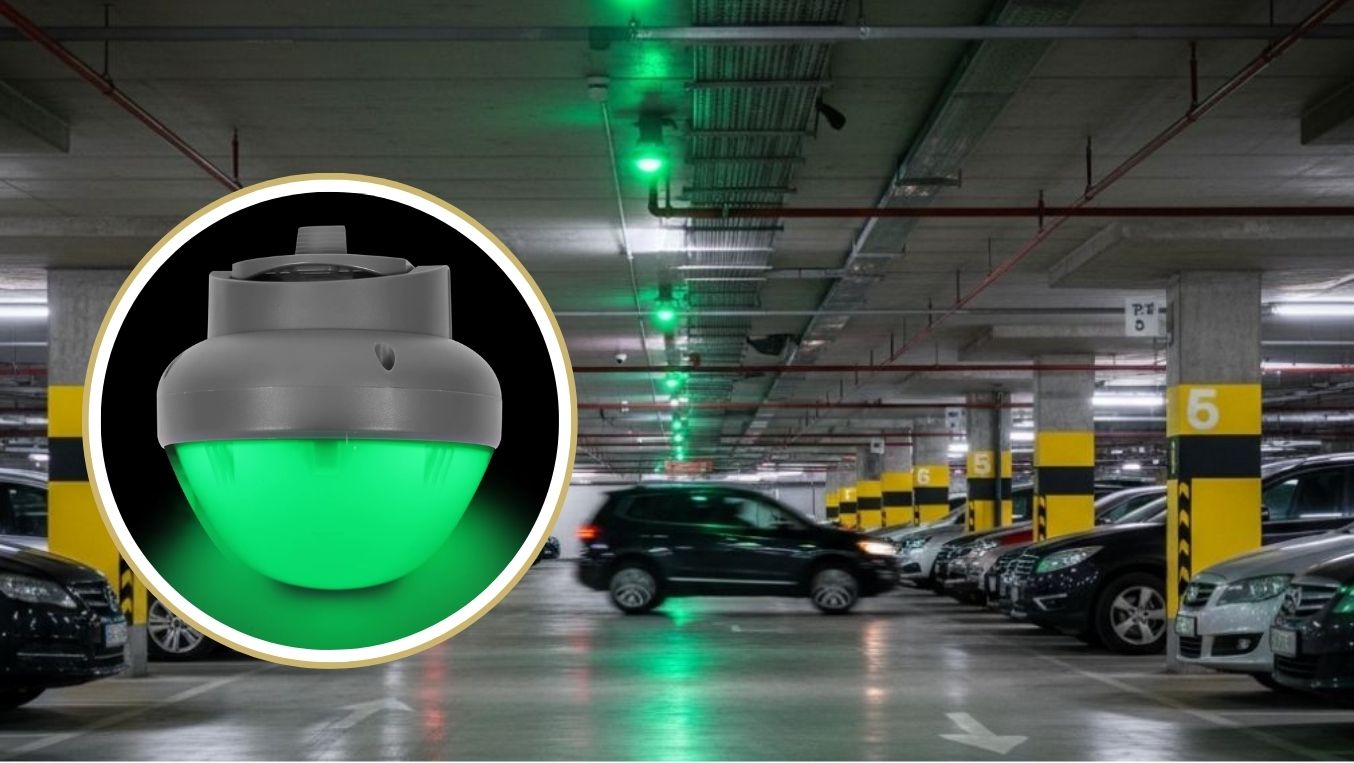
Rather than having a driver guess which aisle might have a free space, the system actively guides them. From the moment a vehicle enters the facility, dynamic signs direct it toward available spaces with precision. When the driver reaches the right zone or row, an indicator light above the space confirms whether it is free or taken.
The result is a smoother, faster parking experience for drivers and a more efficient, better-monitored facility for operators.
In the Middle East context specifically, where large malls, airports, hospitals, and commercial towers generate enormous parking demand, a well-implemented parking guidance system is not a luxury. It is infrastructure.
How Does a Parking Guidance System Work?
The system operates as an interconnected loop of detection, processing, and communication. Here is how that loop functions from the ground up.
Step 1: Space-Level Detection
Every individual parking bay is monitored by a sensor. The sensor detects whether a vehicle is present or absent. This detection happens continuously, updating in real time or near-real time depending on the sensor technology used.
Step 2: Data Aggregation at the Controller Level
Sensors do not work in isolation. They feed data up to local controllers, which are typically installed at the zone or floor level. These controllers aggregate the raw occupancy data from multiple sensors and calculate totals for their section, such as how many spaces are free on level two, east wing.
Step 3: Central Software Processing
The aggregated data flows from floor-level controllers into a central management software platform. This is where the intelligence of the system lives. The software tracks occupancy across the entire facility, manages the display network, generates reports, and provides the interface that parking managers use to oversee operations.
Step 4: Real-Time Display to Drivers
Based on the processed data, the system updates its network of dynamic signs. Large overhead signs near entry points and at each level show total available spaces. Smaller zone signs guide drivers toward the right aisle. Indicator lights at each bay give the final confirmation.
The whole chain from vehicle arriving in a space to the display count updating takes seconds.
Key Components of a Parking Guidance System
Understanding the individual components helps facility owners evaluate what a system needs and what Entry2Exit provides as part of its full deployment.
Ultrasonic Sensors
Ultrasonic sensors are the most widely used detection technology in indoor parking guidance. They mount to the ceiling above each parking space and emit ultrasonic waves. When a vehicle is present, the waves bounce back at a different rate and the sensor registers the space as occupied.
Ultrasonic sensors work reliably indoors regardless of lighting conditions. They are unaffected by shadows, headlights, or varying surface colours on vehicles. Their main strength is consistency.
Infrared Sensors
Infrared sensors use light-based detection and are often chosen for outdoor or semi-covered parking environments. They can detect vehicles at a distance and work well when installed at the entry point of a bay rather than directly overhead. Some facilities use infrared sensors for perimeter detection or at entry and exit lanes.
Camera-Based Detection (Vision Sensors)
Vision sensors use small cameras with onboard image processing to identify whether a space is occupied. These are increasingly popular because a single camera can monitor multiple bays, reducing installation complexity. They also provide visual confirmation that is useful for dispute resolution or security purposes. Entry2Exit integrates camera-based detection for facilities that require both occupancy data and visual records.
Loop Detectors
Loop detectors are inductive loops embedded in the ground at entry and exit lanes. They detect the metal mass of a vehicle passing over them. While they are not used for individual space detection, they are essential for counting vehicles entering and leaving the facility, which gives the system its overall occupancy count.
LED Indicator Lights
Above each parking space, a small LED indicator light tells drivers at a glance whether the space is free. The standard colour convention is green for vacant and red for occupied. Some systems also use blue or yellow to indicate spaces reserved for specific users such as people with disabilities, premium members, or EV charging bays.
These indicator lights are low power, long-lasting, and visible from a distance even in bright conditions.
Dynamic Wayfinding Signs
Dynamic signs are the visible face of the parking guidance system from the driver’s perspective. They come in several formats depending on where they are placed.
Entry Signs: Positioned at the facility entrance, these show the total number of available spaces across the entire car park. If the facility is at capacity, they can display a “Full” message to prevent unnecessary entry.
Level Signs: Located at the entrance to each floor or level, showing available spaces on that specific floor.
Zone Signs: These guide drivers within a floor, pointing toward the zone with available spaces and showing how many are free in that direction.
Row or Aisle Signs: The most granular wayfinding signs, placed at the end of each parking row to confirm availability before a driver commits to driving down the aisle.
Parking Guidance Controllers
Controllers sit between the sensors and the central software. They collect raw data from the sensors in their zone, perform local processing, and communicate up to the central system. Having controllers at the zone or floor level reduces latency and means the system can continue functioning locally even if central connectivity is interrupted temporarily.
Central Management Software
The central management platform is where everything comes together. Operators can view a live map of the entire facility showing which spaces are occupied, monitor entry and exit counts, set alerts for issues like sensor faults, generate occupancy reports over any time period, and integrate the data with other building management systems. We will cover the software features in detail in a later section.
Types of Parking Guidance Systems
Not every parking facility has the same needs, and the market has developed distinct system types to match different environments.
Bay-Level Guidance Systems
These are the most granular systems available. Every individual space is monitored, and every space has its own indicator light. Drivers are guided not just to a zone but to a specific empty bay. This type is ideal for high-density urban facilities, shopping malls, airports, and any location where maximising throughput and driver satisfaction is the priority.
Entry2Exit deploys bay-level guidance as its core offering because it delivers the most complete experience for both drivers and operators.
Zone-Level Guidance Systems
Zone-level systems monitor and display availability at the zone or section level rather than individual spaces. They are less expensive to install because fewer sensors and no per-bay indicator lights are needed. They work well for facilities where exact-bay guidance is less critical, such as large surface lots or lower-traffic locations.
Outdoor Parking Guidance Systems
Outdoor environments introduce challenges that indoor systems do not face: rain, dust, direct sunlight, extreme temperatures, and the need for weatherproof hardware. The Middle East adds heat as a serious factor. Outdoor parking guidance systems use ruggedised sensors and displays rated for harsh environmental conditions. The software logic also accounts for the absence of ceiling mounting, often relying on ground-level or pole-mounted sensors.
Park and Display Systems
Park and display is a simpler variant where the system counts vehicles in and out at a zone or facility level without individual space detection. It is often used for smaller facilities or as a lower-cost starting point before upgrading to full bay-level guidance.
Multi-Facility Parking Management Systems
For operators running multiple parking locations, a centralised platform can aggregate data from all sites. A mall group, a hospital network, or a municipality managing city car parks can view and manage every facility from a single dashboard. Entry2Exit supports multi-site deployments with centralised reporting and parking management.
Features of the Entry2Exit Parking Guidance System
Entry2Exit has designed its parking guidance system with the specific demands of Middle East facilities in mind. The following features reflect that focus.
Real-Time Space Availability Detection
Every parking space in the facility is monitored continuously. Occupancy status updates within seconds of a vehicle arriving or leaving. This real-time data feeds both the driver-facing display network and the management software simultaneously.
Colour-Coded LED Indicators
Green means go. Red means stop. Every driver understands this instinctively, which is why the colour-coded LED indicator system at bay level requires no explanation or training. Entry2Exit uses high-brightness LEDs visible in all lighting conditions, including the strong sunlight entering partially open car parks. Additional colours are configurable for reserved categories.
Multi-Language Dynamic Signage
In the Middle East, Arabic is essential alongside English. Entry2Exit dynamic signs support Arabic-English bilingual display, ensuring the guidance system serves all drivers regardless of language. This matters practically in facilities serving tourists, residents, and workers from diverse backgrounds.
Special Bay Management
Modern parking facilities need to manage more than just regular spaces. Entry2Exit supports dedicated monitoring and enforcement workflows for:
Disabled Bays: Authorised reserved spaces are monitored separately and can trigger alerts if occupied by a vehicle without the appropriate permit.
EV Charging Bays: As electric vehicle adoption grows across the UAE, Saudi Arabia, Qatar, and other GCC markets, facilities need to identify EV bays specifically and potentially integrate with charging station data.
VIP and Reserved Spaces: For corporate facilities, hotels, or premium retail, reserved bays can be assigned to specific users and monitored for correct usage.
Ladies-Only Zones: A number of malls and facilities in the region designate specific zones for female drivers. The system can monitor and guide to these zones separately.
Parking Guidance for Large Vehicles
Standard bay sensors calibrated for passenger vehicles sometimes trigger false readings for motorcycles or struggle to differentiate height-cleared areas for vans and SUVs. Entry2Exit configures sensors appropriately for the vehicle mix of each facility, including supporting dedicated motorcycle bays.
Integrated Entry and Exit Management
The parking guidance system does not exist in isolation. It integrates with the entry and exit control infrastructure: boom barriers, ticketing machines, ANPR cameras, and payment systems. This integration gives operators a complete picture of vehicles in the facility, how long they have been there, and real-time capacity.
ANPR (Automatic Number Plate Recognition) integration is particularly powerful. When a vehicle’s number plate is read at entry, its details can be checked against a database of reserved space holders, blacklisted vehicles, or frequent users eligible for seamless exit payment.
Centralised Management Dashboard
The Entry2Exit management software provides a single interface where operators can:
View a live facility map with occupancy status for every bay. Monitor total occupancy percentages per zone, per floor, and for the whole facility. Receive instant alerts when sensor faults are detected, ensuring the system remains accurate. Track entry and exit events in real time. Pull historical occupancy data for any time period. Generate reports showing peak hours, average dwell times, and space utilisation patterns.
This data is not just operationally useful. It directly informs decisions about pricing, staffing levels, and expansion planning.
Cloud-Based and On-Premise Deployment
Entry2Exit offers flexibility in how the system is hosted. Cloud-based deployment reduces on-site server infrastructure and gives remote access to the management platform from any internet-connected device. On-premise deployment keeps all data within the facility’s own network, which some clients in banking, government, or high-security environments prefer. Hybrid configurations are also available.
Mobile Application Integration
Drivers increasingly expect to interact with parking systems through their smartphones. Entry2Exit supports integration with mobile apps that can show available spaces before a driver even arrives, allow advance space reservation, facilitate cashless payment, and display navigation directions to the facility. For smart city projects and large developments, this app layer connects the physical parking infrastructure to the digital experience drivers already use daily.
Parking Reservation and Pre-Booking
Pre-booking a parking space removes uncertainty from the driver journey entirely. Integration between the parking guidance system and a reservation platform means a booked space can be held, released automatically if the booker does not arrive within a grace period, and confirmed in real time. Entry2Exit supports reservation workflows for facilities that offer this service.
Revenue Management Integration
Parking is a revenue-generating asset, and the guidance system contributes directly to revenue performance. By maximising utilisation, reducing time spent circling for spaces, and supporting demand-based pricing, Entry2Exit’s platform integrates with payment and revenue management systems to close the loop between occupancy data and financial outcomes.
Fault Detection and Predictive Maintenance
Every sensor and display in the network is monitored for health status. If a sensor stops reporting, returns inconsistent readings, or an LED fails, the system flags it immediately. Operators receive alerts and can dispatch maintenance before the issue affects driver experience. Entry2Exit’s diagnostic tools also surface trends that suggest components approaching end of life, enabling planned replacement before failure occurs.
Data Analytics and Reporting
Beyond live monitoring, the accumulated data from a parking guidance system is valuable for understanding how a facility is actually used. Entry2Exit generates structured analytics on daily, weekly, monthly, and custom time ranges. Reports can show occupancy by zone, by hour of day, by day of week, average turnaround time per space, and comparisons across different periods. This intelligence helps facility owners make evidence-based decisions rather than relying on instinct.
Benefits of Installing a Parking Guidance System
The business case for a parking guidance system is built across several areas simultaneously.
Reduced Search Time for Drivers
Studies across parking facilities consistently show that a significant portion of congestion inside a car park is caused by vehicles searching for available spaces rather than vehicles that have a destination. When drivers know exactly where to go, search time drops dramatically. Less circling means less frustration, less fuel consumption, and a better perception of the facility.
Increased Parking Capacity Utilisation
A common finding after parking guidance system installation is that actual utilisation increases, not because more spaces were created but because existing spaces are found and used more efficiently. Spaces in less obvious locations or on upper floors that previously saw low usage are now directed toward because the system shows availability with equal visibility regardless of location.
Lower Operational Costs
With a well-functioning parking guidance system, the need for staff to manually direct vehicles or answer capacity queries reduces significantly. Fewer human interventions are needed for routine operations. Maintenance costs are also managed proactively through the fault detection capabilities, avoiding expensive emergency repairs.
Better Customer and Visitor Experience
For any facility where parking is part of the visitor experience, such as a mall, hospital, hotel, or airport, the ease of finding parking reflects directly on how visitors perceive the entire venue. A smooth, guided parking experience sets a positive tone before a visitor even enters the building.
Environmental Impact
Vehicles searching for parking consume fuel and produce emissions unnecessarily. In a region with extreme heat where vehicles are rarely switched off, idling time in a congested car park adds up quickly. A parking guidance system that cuts search time reduces the environmental footprint of the facility’s parking operations.
Data for Facility Planning
The long-term data generated by an operational parking guidance system is genuinely useful for planning decisions. Knowing which zones fill first, when peak hours occur, and how dwell times vary across the week gives facility managers information that would otherwise require expensive manual surveys to collect.
Increased Revenue Potential
For commercial parking operators, higher utilisation combined with better data for demand-based pricing directly increases revenue. Even for facilities where parking is offered as a complementary service, demonstrating a well-managed, high-capacity parking system supports the broader value proposition to tenants or visitors.
Parking Guidance System vs. Traditional Parking Management
To appreciate what a parking guidance system genuinely changes, it helps to look at what it replaces.
Traditional parking management relies on a combination of manual vehicle counting, static occupancy signs that update infrequently or not at all, and staff on the ground directing traffic. Entry and exit are tracked through ticket machines or manned booths. When a facility fills up, a hand-operated “Full” sign goes up at the entrance.
This approach has clear limitations. There is no visibility into where within the facility spaces are available, so drivers still spend time searching after they enter. Counting errors accumulate over long periods. Staff costs are ongoing and can be significant. There is no data for analysis or reporting.
A parking guidance system replaces most of these limitations. Individual space detection removes the searching problem entirely. Automated entry and exit counting is continuous and accurate. Management software provides the data that manual operations could never practically generate.
The initial investment in a parking guidance system is recouped through lower staffing costs, higher utilisation, and improved customer retention over time.
Installation Process: What to Expect
For facilities considering Entry2Exit, understanding the installation process removes uncertainty about the disruption involved.
Site Survey and System Design
Before any hardware is specified or ordered, Entry2Exit conducts a detailed site survey. This maps the facility’s layout, determines the placement of sensors, controllers, and signs, identifies cabling routes, and confirms the integration requirements with existing systems like boom barriers, payment machines, and building management infrastructure.
The output is a detailed system design document that specifies every component, its location, and its connection pathway.
Hardware Supply and Pre-Configuration
Sensors, controllers, LED indicators, and display signs are supplied and pre-configured before arriving on site. Pre-configuration reduces on-site programming time and minimises the window during which the facility’s operations are affected.
Installation in Phases
For operational facilities that cannot close during installation, Entry2Exit plans deployment in phases. A section of the car park is worked on at a time, allowing the rest to remain in normal operation. This is a critical consideration for malls, hospitals, and other facilities that operate seven days a week.
Cabling and Network Infrastructure
Sensors and displays connect through a data network. Depending on the facility and system design, this may use dedicated cabling, existing structured cabling infrastructure, or wireless communication. The network design ensures reliable, low-latency communication between sensors, controllers, and the central system.
Software Setup and Integration
The central management software is configured with the facility’s layout, zone names, display messaging, alert parameters, and user access controls. Integrations with external systems are tested and confirmed before go-live.
Testing and Commissioning
A full commissioning process verifies that every sensor detects correctly, every display updates accurately, and all integrations function as designed. Entry2Exit runs both automated testing and physical walk-through verification, where vehicles are positioned in spaces to confirm the system’s response.
Staff Training
Facility managers and operational staff receive training on the management software so they can monitor the system, interpret data, and respond to alerts. Entry2Exit provides both in-person training sessions and documentation for ongoing reference.
Ongoing Support
Post-installation, Entry2Exit provides technical support for the system with service level agreements covering response times for faults. Remote diagnostics mean many issues can be assessed and often resolved without a site visit.
Factors to Consider When Choosing a Parking Guidance System
Every facility is different, and choosing the right parking guidance system requires evaluating several key factors.
Facility Type and Size
A 200-space single-level hospital car park has different requirements from a 3,000-space multi-storey mall facility. Scale affects both the component count and the system architecture needed to manage it reliably.
Indoor vs. Outdoor Environment
Indoor facilities allow ceiling-mounted ultrasonic sensors in a controlled environment. Outdoor facilities require weatherproof hardware, different mounting strategies, and sensors that tolerate temperature extremes, dust, and direct sunlight.
Integration Requirements
If the facility already has boom barriers, a ticketing system, ANPR cameras, or a building management system, the parking guidance system needs to integrate with these. Confirming compatibility and integration capability before selecting a provider is essential.
Budget and Phasing
For large facilities, phased deployment may be more financially manageable than a full installation at once. A well-designed system can be expanded in phases without requiring the initial deployment to be redone.
Scalability
The facility you are managing today may grow or change. The system you choose should be able to scale without requiring complete replacement. Entry2Exit designs its systems with expansion in mind.
Local Support and Maintenance
A parking guidance system is infrastructure that runs continuously. When something goes wrong, you need a support partner who can respond quickly. Local presence matters for a system like this. Entry2Exit operates in the Middle East with local teams able to support installations across the region.
Parking Guidance System Applications Across Industries
Parking guidance systems are deployed across a wide range of facility types, each with its own priorities and user expectations.
Shopping Malls
Malls are probably the most common deployment environment for parking guidance systems in the Middle East. High footfall, peak-period congestion, and the direct link between parking experience and retail dwell time make the case compelling. Malls also often have complex layouts with multiple levels, multiple entrances, and designated zones for different users, all of which benefit from systematic guidance.
Airports
Airport parking combines high volumes with time-sensitive drivers, many of whom are stressed about catching flights. A parking guidance system that eliminates search time and provides clear directional guidance to the nearest available space has an immediate and measurable impact on the passenger experience.
Hospitals
Hospital visitors are often already dealing with stressful circumstances. Arriving to find a parking facility where they have to search without guidance adds to that stress. Hospitals also have a mix of user types including patients, visitors, staff, ambulance access zones, and disabled bay requirements, all of which a parking guidance system can manage and monitor distinctly.
Corporate Office Buildings
For corporate campuses or towers with assigned and unassigned parking, a guidance system provides clarity for visitors and flexibility for operators. Staff spaces can be managed through reservation integration, and visitor spaces can be guided dynamically.
Hotels and Hospitality Venues
The first impression a hotel creates begins in the car park. A smooth, guided entry experience with clear signage and indicator lights reflects well on the property before a guest reaches the lobby. Valet integration is also possible for properties that offer this service.
Universities and Educational Institutions
University campuses often have multiple parking areas serving different buildings, with distinct user categories for students, staff, and visitors. Guidance systems with zone differentiation and permit integration help manage these environments efficiently.
Stadiums and Event Venues
Event venues see enormous spikes in parking demand that begin and end within a short window. A parking guidance system helps distribute vehicles efficiently across available zones during the arrival rush and provides data that supports post-event egress management.
Government and Municipality Car Parks
Public parking managed by municipalities benefits from the data and efficiency a guidance system provides. Usage data informs planning decisions, while driver-facing guidance reduces congestion in urban areas.
Smart Parking and the Future of Parking Guidance
Parking guidance systems are not static technology. The direction the industry is moving is toward greater integration, greater intelligence, and greater connectivity with the broader urban environment.
Integration with Smart City Platforms
Progressive municipalities in the Middle East, particularly in the UAE and Saudi Arabia as part of Vision 2030 initiatives, are developing smart city platforms that aggregate data from multiple urban systems. Parking guidance systems are a natural contributor to this ecosystem, providing real-time occupancy data that can be surfaced on city-wide apps, navigation platforms, and traffic management systems.
Predictive Occupancy
Using historical data, machine learning models can predict with reasonable accuracy how occupied a facility will be at a given time on a given day. This predictive capability allows facilities to communicate expected availability in advance and helps drivers plan their arrival time.
Integration with Navigation Platforms
When parking guidance systems share availability data with navigation platforms, drivers can be directed to a specific parking facility knowing in advance that spaces are available, and can even be guided to the optimal entrance. This reduces approach-road congestion as well as in-facility searching.
EV Infrastructure Integration
As EV adoption increases, parking facilities need to manage charging bay occupancy alongside standard space occupancy. Parking guidance systems that integrate with EV charging management platforms can show which charging bays are available, what charging speeds they support, and guide EV drivers accordingly.
Contactless and Frictionless Parking
The combination of ANPR, pre-registered payment methods, and parking guidance creates a frictionless experience where a driver enters, parks, and exits without stopping at any payment point. The system handles entry recognition, duration tracking, and payment automatically. Entry2Exit’s integration capabilities support this model for facilities ready to offer it.
Why Choose Entry2Exit for Your Parking Guidance System?
Entry2Exit brings specific advantages to parking guidance system deployments across the Middle East.
Regional experience matters. The environments here, from the extreme summer heat affecting outdoor hardware longevity to the multilingual user base requiring bilingual signage, are not identical to European or North American markets. Entry2Exit has built its system specifications and deployment practices around regional realities.
The full system scope matters too. Some providers supply sensors. Others supply software. Entry2Exit supplies and supports the complete system from individual bay sensors through to the management platform and integration with entry and exit control. Having a single accountable partner for the full scope simplifies deployment and ongoing support.
The quality of post-installation support matters enormously for a system that never switches off. Entry2Exit’s local presence means technical support is accessible, response times are practical, and maintenance is delivered by teams who know the system and the region.
Frequently Asked Questions About Parking Guidance Systems
How accurate are parking guidance sensors?
High-quality ultrasonic and camera-based sensors used in Entry2Exit systems achieve accuracy rates above 99% in controlled indoor environments. Outdoor installations are calibrated for environmental factors that could affect detection. Regular fault monitoring ensures sensor accuracy is maintained over time.
How long does it take to install a parking guidance system?
Installation timelines depend heavily on facility size and complexity. A 500-space single-level facility might be fully commissioned in a few weeks. A 3,000-space multi-storey deployment with phased installation to avoid operational disruption could take several months. Entry2Exit provides a detailed project timeline during the design phase.
Can a parking guidance system be added to an existing car park?
Yes. Parking guidance systems are frequently installed in existing facilities. The installation approach adapts to the existing structure, using the available ceiling height, column positions, and cabling routes. There is no requirement for the facility to be purpose-built for guidance system installation.
Does the system work if the internet goes down?
Entry2Exit systems are designed with resilience in mind. Local controllers continue to operate and can maintain display accuracy even if central connectivity is temporarily lost. Core parking guidance functions remain operational. Cloud-dependent features like remote management access would be unavailable until connectivity is restored, but on-site operations continue.
What is the lifespan of parking guidance system components?
LED indicator lights have typical operational lifespans of 50,000 hours or more. Ultrasonic sensors in indoor environments typically last many years with minimal maintenance. Dynamic display signs have similar longevity. The fault detection features of the management software help identify components approaching end of life before they fail.
Can the system handle reserved and unreserved spaces differently?
Yes. Reserved spaces can be assigned specific colours on the LED indicator (often blue or yellow), monitored separately in the management software, and integrated with reservation or permit management systems. Violations of reserved space usage can be flagged automatically.
How does the system count vehicles entering and exiting?
Loop detectors at entry and exit lanes detect vehicle passage. ANPR cameras read number plates for identity confirmation. These counts are reconciled continuously to maintain an accurate total of vehicles in the facility. The counts feed into the overall availability displayed on entry signs.
Is the system suitable for outdoor parking in hot climates?
Yes. Hardware specified for outdoor deployment in the Middle East is rated for high ambient temperatures and direct sun exposure. Entry2Exit selects components with appropriate IP ratings for dust and moisture protection and thermal ratings for the temperature ranges experienced across the GCC.
Can multiple parking facilities be managed from one platform?
Yes. Entry2Exit’s management platform supports multi-site deployment, giving operators a single dashboard view across all facilities with the ability to drill down into individual sites or zones as needed.
What data does the management software provide?
The platform provides live occupancy status, historical occupancy data over any time range, peak usage analysis, average dwell times, entry and exit event logs, sensor health status, and customisable reports. This data is accessible through the web-based dashboard and can be exported for use in external reporting tools.
How does a parking guidance system reduce congestion?
By directing drivers to available spaces immediately rather than allowing them to search, the system eliminates the circling behaviour that causes most internal car park congestion. Fewer vehicles in motion at any time means less competition for aisles and smoother flow throughout the facility.
What is the return on investment for a parking guidance system?
ROI comes from multiple sources: reduced staffing requirements, higher space utilisation, improved customer satisfaction supporting business retention, and data-driven operational improvements. The specific ROI calculation depends on the facility’s size, current operational costs, and the value placed on visitor experience. Entry2Exit can support this analysis during the design phase.
